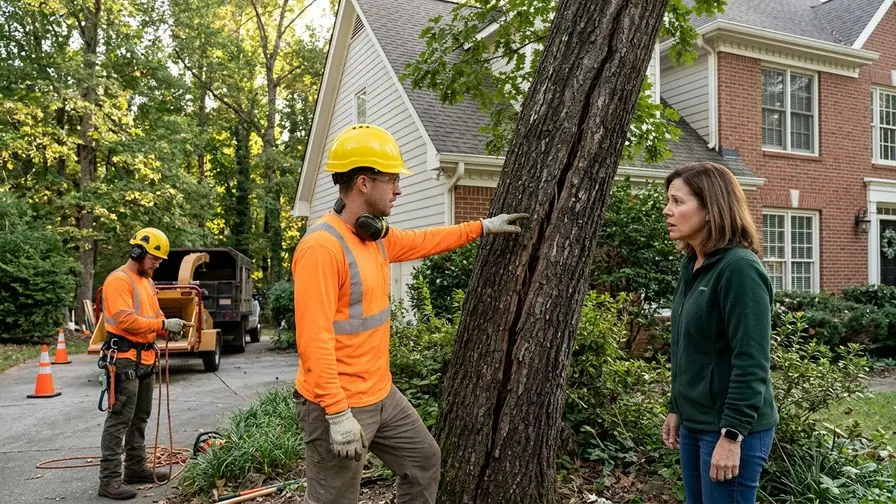
Most trees give clues before they fail. The trick is knowing where to look. This article is a simple ground-level checklist you can use on any tree in your yard, whether you live near Martin's Landing or closer to downtown Roswell.
What are the warning signs of a hazardous tree?
The main warning signs of a hazardous tree are deep cracks in the trunk or major limbs, a lean that is new or getting worse, large dead branches, fungus or soft wood at the base, and soil heaving or cracking around the roots. One sign alone may be minor. Several together, on a tree that could reach the house, call for a prompt professional look.
Base >>
- Fungus, cavities, cracked or heaving soil.
Crown >>
- Dead limbs, hangers, sudden thinning.
Start at the Roots
The root plate is the foundation of the tree. Walk around the base and look for mushrooms, conks or other fungus growing from the roots or lower trunk. These often mean decay inside.
Look at the soil too. Cracks in the ground, a raised mound on one side, or roots that seem to be lifting out of the soil can mean the root plate is shifting. Construction, trenching or grading near a tree can damage roots and show up as problems years later. Any change at the base after a storm deserves attention.
Move Up the Trunk
Look for long vertical cracks, especially those that go deep into the wood. Check where two main stems meet. A tight V shape with bark pinched between them is a weak joint that can split.
Cavities, oozing wounds and areas where bark has fallen away to reveal dry wood are other clues. Note any lean, and compare it to old photos if you have them. A lean that appeared or increased recently is a bigger concern than one the tree has grown with for decades.
Finish in the Crown
Scan the canopy for large dead branches. They are often bare, gray and have no leaves when the rest of the tree is green.
Look for broken limbs still hanging in the tree. Compare the crown to nearby trees of the same type. If it is much thinner or has dieback at the top, the tree may be in decline. Then consider the target: what would it hit?
When to Get a Second Opinion
If you spot several of these signs on a tree near your home, it is worth a professional look. Call us and we will connect you with a local provider who can inspect it and explain what they see.
Questions Roswell Homeowners Ask
Is a leaning tree always dangerous?
A leaning tree is not always dangerous. Many trees grow with a steady lean and stay stable. A lean is more concerning when it appears suddenly, gets worse, or comes with cracked or lifted soil at the base. Those signs suggest the roots may be failing.
What does fungus on a tree trunk mean?
Fungus on a tree trunk or roots often means there is decay inside the wood. The fungus you see is the fruiting body, while the decay can extend much further inside. A tree with fungus at the base should be checked, especially if it could hit a structure.
What is a codominant stem?
A codominant stem is when a tree has two main trunks of similar size growing from the same point. If they form a tight V with bark pinched between them, the joint can be weak and may split, particularly in storms. Some can be cabled; others are removed.